Wednesday, October 31, 2012

Stifled Young Women

A comparison of  Elfriede Jelinek's The Piano Teacher  book with Darren Aronofsky's  Black Swan movie

To the audiences of the movie Black Swan and the readers of the book The Piano Teacher, the story narrated was more than a little disturbing. The storyline in both these works followed the unravelling of extremely disturbed young women.


The Piano Teacher tells the story of a frustrated young lonely woman Erika Kohut who has been denied her liberty by her domineering possessive mother. She is not talented enough to touch real success and to her dismay she is unfit for any other calling. She has no outlet in which to express her rage and she is unable to have a normal relationship with anyone thanks to her mother. The mother-daughter relationship is based on her mother's fear of being left alone and unwanted and Erika's own insecurities and fears. Erika finds her life unbearable and tries to escape its suffocating monotony and emptiness by losing herself in her fantasies - primarily sexual and suicidal. Jelinek takes us on a trip through Erika's mind that tells us her past, her sorrows, her dirty habits, her slow descent into insanity and the reason that she will never escape this mundane existence. Her affair with her student is just another failed attempt to escape her torrid life.

Black Swan/White Swan - nfs -- Johanna Bohoy Swan Lake

Black Swan is the story of a fragile young ballerina Nina who is pushed beyond her limits in the role that she coveted her whole life viz., the swan in Swan Lake. She is controlled by her mother - a former ballerina. She is slowly but surely pushed away from her moorings by a current that is too strong for her to resist. Nina is confronted with events she cannot handle - the downfall of the prima ballerina, the twisted friendhip of her rival, the sexual advances of the director of the company, the increasing hysteria of her mother, the betrayal of her mind.... The film is shot in such a way that the audience too is caught and swept away from reality by the story of Nina's triumph and her eventual downfall.

The stories are so similar. The diseased mother-daughter relationships, the absent father figure, the unbearable loneliness faced by both Erika and Nina, the overwhelming feeling of fear of an unknown catastrophe, the unfulfilled sexual longings, the eventual doom.

The most unsettling aspect of these stories is this - the prospect of mad young women moving among us with no hope of ever being set free from their insanity. There is no knight in shining armour to gallop up to the rescue.


Thursday, July 12, 2012

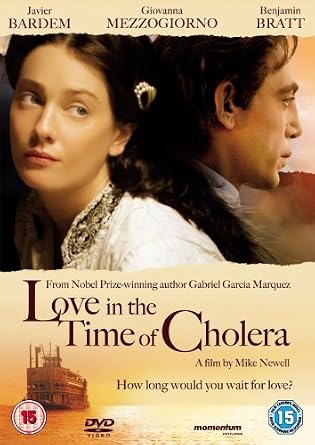
Love in the Time of Cholera by Gabriel Garcia Marquez

 https://archive.org/services/img/isbn_9780140126679
Dr. Juvenal Urbino dies while trying to catch his wife's pet parrot - his only regret as he feels his life slipping out of his body is that his wife - Fermina- will be left alone. This is the beginning of one of the strangest love stories I have ever read. From here we are taken back in time, to when Fermina was young. [The flashbacks in this story are done very smoothly. ]


The tone of the book is similar to a Jane Austen novel - if JA had ever gone to Latin America and lost some of her prudishness. Marquez makes references to using enemas, affairs with extremely young girls, adulterous affairs that are unsatisfying, and body odours among other things that are very disturbing. The most disturbing aspect of this novel is Florentino - Fermina's lover from the time she was 14. Florentino is a stalker. He constantly keeps watching Fermina from afar after she breaks up with him. He refuses to allow any other woman take her place in his heart in spite of the fact that he does not actually know her.

 http://cdn.cnn.com/cnnnext/dam/assets/140417231056-07-marquez-quotes-horizontal-large-gallery.jpg

The good thing about Marquez is that he never judges his characters - there are no villains in this story. Every character is portrayed with some amount of sympathy except the Mother Superior at Fermina's school.

The storyline is not particularly remarkable. -two guys, a girl, a declining city, awful relatives, nice relatives, and a succession of Florentino's lovers. The characters are not nice, the plot is not innovative, the descriptive passages describe ugliness more than anything else.  It does not sound interesting yet I still managed to finish the book. Why? For one reason only -  Marquez has the uncanny ability to slip something shocking into every chapter. I read till the end to find out just how outraged he could leave me. I was not disappointed.

Would I recommend the book? Not really. Unless, the person asking is a historian who wants to feel nostalgia for a time before the conveniences of modern life swept the old order away.

http://www.imdb.com/title/tt0484740/ - read about the movie based on this book.

 https://images-na.ssl-images-amazon.com/images/I/51jCVDSkmIL._SY445_.jpg

Thursday, March 1, 2012

Alexander Solzhenitsyn - One day in the life of Ivan Denisovich

This book is well-known for good reason. It is one of the best books to come out of Russia during the time of the Soviet Union. Why is it so likable? Easy question.

This book describes the life of a prisoner in a concentration camp by taking us through his daily routine. The lack of sleep, food, the bitter freezing cold, the injustices, are all dealt with in a manner that neither emphasises the hardship nor makes it sound easy. Ivan Denisovich simply was a returned POW who didn't have a quick enough tongue at the right moment. Most people don't. But while most others merely suffer a temporary inconvenience or set back, Ivan ends up serving 10 years in a concentration camp in Siberia.

He has learnt how to cope with life inside the camp. After all 8 years of his sentence are up. Throughout his day, we are fed with all the tips for survival that can determine whether one survives the sentence or not. He is someone who is naturally caring, and sympathetic but has been forced to be self-centred. He is skilled and does his work without complaint. His criticism of the aspects of camp life are both cutting and amusing. For Example: he describes the inability of guards to keep count of prisoners and tells us how illiterate semi-skilled shepherds are far superior in their ability to keep track of sheep.

The narrative voice follows Denisovich i.e. the novel is not in first person but is told by a voice that seems to observing like a parasite on the shoulders of Denisovich. There are no passages where the author takes us away from the story to explain his personal philosophy. He allows the story to speak for itself.